


Description
Heading : Square Wooden Box with Early Print of The Pantiles. Tunbridge Wells c1795
Date : c1795
Period : George III
Origin : Tunbridge Wells. possibly London
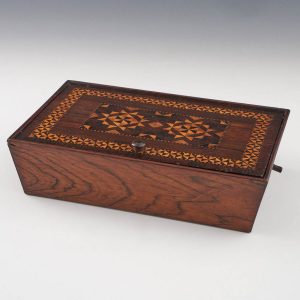
Description : A shallow. square box with a sliding lid seated in fitting in to grooves on three sides and with an attached. mitred strip of wood attached to one side as the handle; internally. divided in to four compartments. relined with red paper over the original pink. which can still be seen on the underside of the lid
Decoration : A border of nine different strips of banded and continuous keyline stringing around a plain veneer lid; the lid is decorated with an oval-shaped cut-out of a print of The Pantiles – known as The Walks at the time it was published – surrounded by further inlaid. banded keylines (hence our designation as this as a piece of Tunbridge Ware)
Size : 15.4 x 15.4 x 4.5 cm
Condition : Very good; solid construction. though somewhat worn as to be expected; the lid is a little bowed. but still slides easily and closes firmly
Restoration : none
Weight : 186 grams
Notes : This is unlike any other Tunbridge Ware boxes that have passed through our hands. although – as above – the inclusion of inset. banded key-line stringing prompted us to list it under this category; the nature of the mounted print also demands that this be the case too. It is an image of The Pantiles. viewed from the end nearest the chalybeate spring. looking down towards the distant pump house. It was published in the first 1780 edition of Jasper Sprange’s Tunbridge Wells Guide. and was the work of Messrs James Roberts (the artist) and William Walker (the engraver). and also appeared in subsequent reprints. Sprange was a printer. publisher and bookseller – working from his premises on The Pantiles – and he undertook all three roles for this particular tome. The underside of the lid still bears an original cutting taken from the book which states ‘A Perspective View of Tunbridge Wells Walks – Publish’d & sold by J Sprange Bookseller Tunbridge Wells.’ (this ‘label’ can be matched with images which show the full. un-cropped frontispiece of the book). On this basis. our date of 1795 may be somewhat conservative.
Identification of the exact position of the artist as he drew his sketch is difficult to establish. but we would surmise that he may well have been standing to the right of what is now known as the Fish Market. with the Gloster Tavern (now a cookware shop) on the left hand side. immediately adjacent to the Musick Gallery (as termed in the 1759 Rusthall Manor Act documentation); further down on the right is the appropriately named High House which would be better known to present-day locals as The Swan Hotel. as was.


Reviews
There are no reviews yet.