









Description
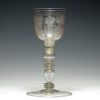
Heading : Potsdam engraved goblet
Date : 1640-1680
Period : Mid 17th Century
Origin : Nuremberg. Germany
Colour : Clear
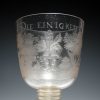
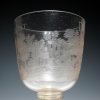
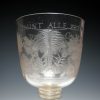
Bowl : Round funnel engraved with the words ‘DIE EINGEKEIT GRUNT ALLE ZEIT’. a gentleman in period dress carrying a Beehive and fronds. palm trees. ruins. a boat and a farming scene. (see additional information)
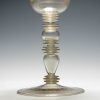
Stem Features : Hollow flattened ball and hollow inverted baluster separated by multiple merese
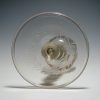
Foot : Conical. folded and engraved with ferns
Pontil : Snapped
Glass Type : Soda
Size : Height 19.7cm. bowl 7.5cm. foot 10.5cm
Condition : Very good. As expected with a glass 350+ years old there are some very minor issues. The glass has some mild crizzling that can only be seen under a very strong light. There is also a small internal anealing fault on the underside of the foot from manufacture which is hidden by the engravings. there is no associated bruise or chip. Overall. for its age the glass is in remarkably good condition.
Restoration : None
Weight : 197 grams
Additional Information :
Many thanks to JB for the research and opinion below
The symbolism is a derivative of long traditions some of which stretch back to the classical period so that the symbolic meaning retains significance but. in my view. in a different way.
The beehive is an ancient symbol of industry and the palm tree of victory. triumph and peace. The principal figure also wears a laurel crown or wreath signifying both victory and status.
Given his proportion vis-à-vis the remainder of the engraving. it seems to me that the figure must be given an allegorical significance and ‘he’ (whoever ‘he’ is) comes wreathed in laurel and bearing the symbols of industry. victory and peace.
He appears in an overgrown landscape. with derelict buildings out of which trees appear to be growing and what appears to be a vibrant willow tree near water. The willow is associated with renewal. growth. vitality and immortality in countries from England to China. The Christian connection between death and willows is thought to originate with Psalm 137. which refers to willow trees and grief.
All this seems to me to point to an era of renewal from past destruction and despoliation.
The obvious question is whether there is any historical event to which all this symbolism might refer in the timeframe which you give for the dating of the glass?
During the first half of the 17th century Europe suffered the devastations of the Thirty Years War which ended with the Treaty of Westphalia in 1648. The wars had a particularly devastating effect on vast tracts of what is now Germany with a huge population loss as a direct result of the fighting. The Treaty resolved much of the religious basis which had fuelled the long period of war and led to the permanent loss of the Spanish European possessions which had been such a catalyst of the upheaval. with a real hope for renewal and a return to some sort of normality.
Is it fanciful to regard the giant figure. bearing symbols of hope for the future. as a representation of pan-Germania. with the aftermath of the many years of devastation around him in the overgrow foliage and ruinous buildings and the symbolic willow tree further symbolising potential renewal?
During the two years of negotiations which lead to the signing of the Treaty. there must have been growing optimism and a very real sense of relief and hope of a brighter future once the Treaty was finally signed. That such euphoria was proved not altogether well-founded by subsequent events cannot diminish what must then have been a period of great hope for renewal in the new peace. I cannot think of any other scenario which would have had such a cataclysmic effect on large numbers of the European population during that time period.
This would date the glass earlier than the date suggested when it was sold by Sotheby’s.
References :
Sotheby’s The Krug collection part IV ( p113) Lot 770 14th March 1983
Sotheby’s Lot 132 28th June 1971
http://www.sothebys.com/en/auctions/ecatalogue/2007/a-personal-view-on-glass-the-zoedler-collection-l07653/lot.2.html
http://www.sothebys.com/en/auctions/ecatalogue/2007/a-personal-view-on-glass-the-zoedler-collection-l07653/lot.3.html
http://metmuseum.org/art/collection/search/195886
http://www.artfinding.com/272/Kunstzalen-A-Vecht/6484/Hermann-Schwinger/Goblet-and-cover


Reviews
There are no reviews yet.