


Description
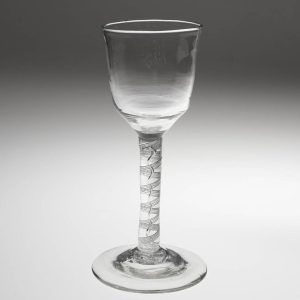
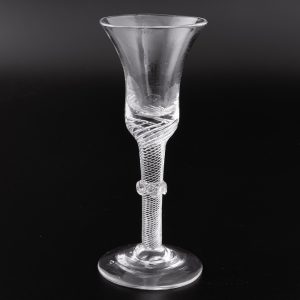
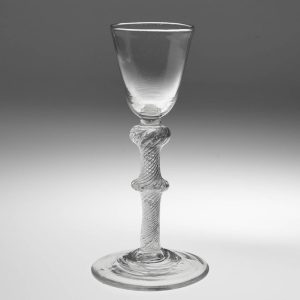
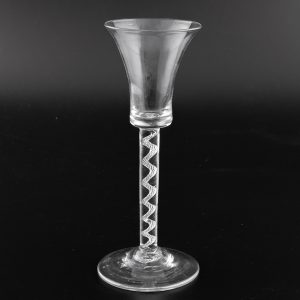
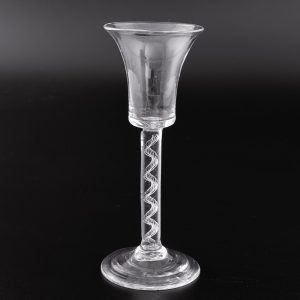
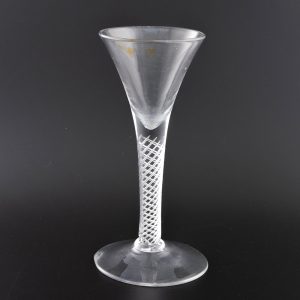
Heading : A Georgian air twist stem wine glass
Period : George II
Origin : England
Colour : Clear. good dark hue
Bowl : Drawn trumpet. good pucella marks
Stem : Tapered with good marvering lines. A pair of flattened air threads around a twisted air vertical core
Foot : Thick conical
Pontil : Snapped
Glass Type : Lead
Size : Height 16.0. diameter bowl 6.6cms .foot 7.5
Condition : Excellent. no chips or cracks.
Restoration : The underside of the foot has been polished and the foot rim
Weight: 280grams
The thick glass stem would have most offering an Irish attribution without hesitation as this is the commercially the most viable option. This is heavy for a glass of this stature and the stem and foot are very thick.
Air twist glasses were made in England from the reign of James II. there is a very rare example in the Victoria and Albert museum dated to c1680. Barrington Haynes states that the earliest examples were made from 1745 onwards. Other authors state 1730.
The heavy construction and drawn trumpet bowl do indicate an earlier date if English 1730-50 is perfectly reasonable. This does not have a refined multi-series twist that would definitely require a later date being attributed.
The construction is consistent with air twist wine glasses known to have been produced in Ireland in the 1780s but in small quantities. The parliamentary register of 1779 details numerous debates on both the Irish glass and wool industry. There was a complete embargo on the exportation of glass and wool form Ireland. Only “British” glass could be imported into Ireland. The parliamentary record clearly states that Ireland was a huge importer of glassware and that fledgling local manufactories were incapable of meeting internal demand. The possibility that Ireland may one day be in a position to export glass was openly derided.The use of wood to fire glass furnaces in Ireland had been banned in the 18th century. Coal was permitted however the mines were for the most part English owned and coal was taxed. Coal was also in short supply in Ireland. there were more coal mines in the Cannock Chase than in the whole of Ireland.
It is no coincidence that the major Irish glass industries grew up for the most part around ports.Alice Murray states that no glass was exported from Ireland before 1782. there are no records of export and furthermore production capabilities were naive. Thus there are seemingly highly disproportionate quantities of glass attributed to Ireland and purportedly made prior to 1770 and the advent of the Tyrone and Belfast glassworks founded by Benjamin Edwards in the early 1770s and 1775 respectively.
Free trade agreements stimulated considerable investment in the industry and the Penrose family grasped the opportunities presented and opened a factory at Waterford in 1783.
When drinking glasses were finally exported from Ireland the vast majority went to the Americas. not Europe. On balance this may be Irish but common sense dictates that this is highly improbable. The safe attribution is a pre-glass tax English example despite Irish attrubution commanding higher prices.
Be wary of Irish glass this is fertile ground for those proven to be mendacious. From Mrs Graydon Stannus whose own seminal work on the subject of Irish Glass included images of forgeries made by her own hand. to te present day the myth is still being perpectuated for commercial gain
Reference: History of Commercial and Financial Relations Between England and Ireland. Alice Murray p278
Common Sense 101.
Reviews
There are no reviews yet.