




Description
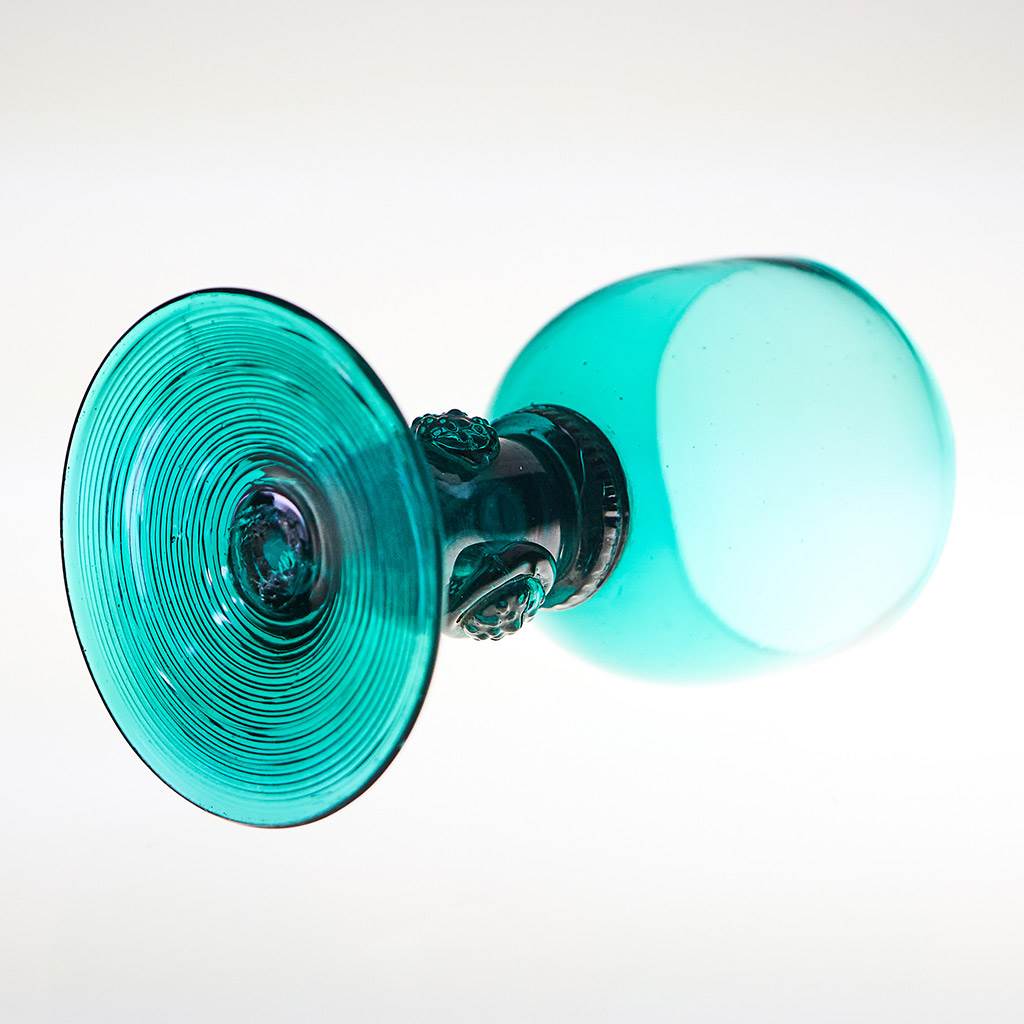
Heading :An English lead glass roemer hock glass
Period : George III – George IV- c1820
Origin : England
Colour : Green
Bowl : Cup
Stem : Hollow. Applied raspberry prunts with an crimped collar
Foot : Conical with trailed decoration on the upper surface
Pontil : Snapped
Glass Type : Lead
Size : 12.3cm height. 6.5 cm diameter bowl. 7.1 cm diameter foot . minor variations
Condition : Excellent. Some fine inclusions within the glass . These are clearly visible within the images.
Restoration : None
Weight: 612 grams
One of the primary pieces of dating evidence on such tankards is the decoration itself. Is this hand applied trailing or machine applied threading ?
When hand applied the threads (called trails) are not uniformly distributed and are of variable thickness. The threads become progressively thinner towards the stop point.
On machine threaded examples the threads are tightly packed together. evenly spaced and of uniform thickness.
Trailing was a widely used decorative technique in ancient Egypt and remains one of the most common forms of decoration. Nailsea glass was produced by trailing a coloured thread upon a vessel before continuing to blow and mould to the required size.Trailing was also used on the rims of multiple Georgian tankards.
It was not until the mid 1870s that threading machines were invented and their adoption will have been rapid as with most labour and cost saving devices. The same threading machines remained in use up to the second world war.


Reviews
There are no reviews yet.